Read if you like:
- D&D
- Eberron
- Fantasy adventures
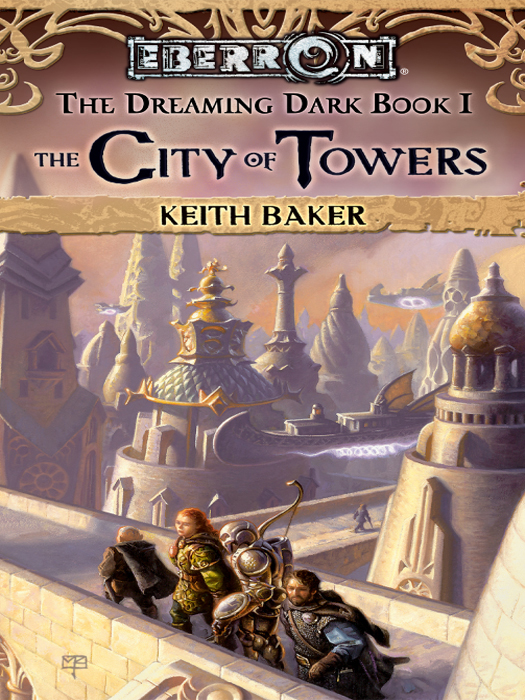
I’ve always loved used book stores: the smell of old books, the dark homey corners, and the wonderful profusion of oddball novels that never reached any great degree of fame all call to me on an almost spiritual level. With that in mind, it should come as no surprise that eventually the result of such a book run would find its way to this blog, with The City of Towers by Keith Baker taking center stage on this occasion. But as much as I enjoyed finding the book, the actual experience of reading it didn’t prove to be quite as good.
The Good
The City of Towers is a fast-paced fantasy adventure set in the wonderful Eberron setting. For those not familiar with Eberron, the world is a D&D setting created by Keith Baker himself for a contest in 2002 run by Wizards of the Coast to create a new official setting. Chosen from among thousands of entries, Eberron is a fascinating world of airships and artificers threatened on many sides by a menagerie of extra-dimensional menaces. The setting remains a popular one to this day with a source book for it being released for 5e in recent years. As a backdrop it makes for a wonderful setting for any novel which in itself already made me inclined towards the book even before I turned the first page.
As for the novel itself, there are some good things going for it. Taking place in the aftermath of a continent-spanning war, the novel follows a band of ex-soldiers struggling to find a place to belong after their nation is destroyed in a magical cataclysm that sets in motion the war’s end. Without purpose or nation, the band follows one of their members home to Sharn, the City of Towers. Once they arrive, however, they quickly discover that Sharn has its own secrets and mysteries and it’s not long before they find themselves in the midst of conspiracy that could threaten the city as a whole.
The cast itself is an interesting mix of characters. The leader, Daine, is a human career solider and seasoned leader struggling with regrets and guilt for past misdeeds. Lin, the group’s mercenary artificer (think magic engineer) is a member of House Cannith, a quasi-guild of individuals with powerful ‘dragonmarks’ that grant the bearers unusual magic talents. Intelligent and loyal to family and House, she is the driving force behind the group’s journey to Sharn before events conspire to leave her just as aimless as her companions. Jode is a halfling with a silver tongue and a dragonmark that grants him healing powers. Quick-witted and cheerful, he is as quick to get the party into trouble as he is out of it. Finally there is Pierce, a warforged (a kind of magical robot) who is struggling with his purpose and identify now that the nation and war he was built to serve are gone.
It’s a good cast with a mix of roles. No one here is especially unique in the annals of fantasy characterization, but at the same time no one feels like a paper-thin character meant to fill out the cast. Everyone has their own strengths, flaws, and goals in the group as they struggle to survive after having lost almost everything. Put together, they are a force to be reckoned with, which, as it turns out, is a rather good thing given how quickly they tend to get into trouble.
The other stand-out element is Sharn itself. The City of Towers is a wonderous cityscape of magic and politics. Despite almost entirely taking place within its walls, the setting is never boring as the characters travel between incredibly varied districts. From the lower ghettos where orcs and goblins live to the upper spires where magic is as common as air, Sharn is a microcosm of what Eberron is about, fantastical sights mixed with grim conflicts. There is no attempt to sugar-coat the themes of racism and division that Eberron emphasizes. ‘Monsters’ are treated horribly while the ‘good’ races can be far more cruel with far less justification. And under it all the forces of ancient evils are waiting for a chance to break free and condemn the world in their own special way. At the same time though there is a sense of a unified Sharn in each of those varied districts. The city has a history and culture that permeates throughout its wildly different corners, helping to keep the city feeling real.
The Bad
While I enjoyed the novel, the truth is I was not astounded by it. Part of it could be summed up to first novel syndrome, as the book feels like it has too many details and plot threads for a single opening novel to properly contain. There are secrets that remain unanswered by the novel’s end that honestly feel like they could have been introduced later on in the series, and a lot happens that doesn’t really push the first novel forward all that much. That said, having started the second book, I can already see some of those plot threads being picked up again and to the author’s credit, this is, as near as I can tell, his debut novel, so I can forgive the lack of polish here and there. In a similar vein, the writing itself was solid but not exceptional. Some authors pull you in with their linguistic skills, either with carefully crafted sentences or with a persistent wit. Baker, for his part, never manages to reach that sort of level. It’s never bad writing, but it’s just not great either. But, once again, this is his debut novel and no one masters the craft of writing in a single book, so it’s not really worth bemoaning too loudly.
The plot on the other hand I was a bit less forgiving of. It’s not a bad story per se, but the book spends more time than it should throwing in future plot threads rather than building up the one the book actually has. A lot happens, too much really, muddling any sense of what you need to actually remember. Add to that the rather quick pace of the story and a lot of the plot ends up feeling a bit too vague in the build up. In addition, it feels like the book could have done with a good bit of ruthless trimming. Even ignoring elements that look like future plot development, there’s still a good few scenes that really don’t need to be there. The story needs polish, and I think Baker needed to be less ambitious in a lot of ways. This is the introductory story for his characters, after all, and we should be learning more about them than about future plotlines, which brings me to another big complaint.
In addition to all the pacing and plotting issues, the characters feel just a bit flat. They’re a good mix of personalities with a lot of potential, but in many ways they don’t quite hit the ground running. I suspect that as I read more into the series I’ll come to like them more, but at the moment there just seems to be a degree of unfulfilled potential. Beyond the book’s clutter, part of it may have to do with the fact that all the characters present in the main cast have known each other for a good amount of time beyond what is covered in the book. They have pre-existing history, which means you don’t get to see their initial friendship develop, which in turn makes it harder to feel them out as characters. You don’t need a cast of new acquaintances, but it requires a somewhat more deft hand to write old friends instead of new ones than Baker shows in this novel.
Conclusion
I’m hesitant to encourage or discourage anyone from reading this book. It’s neither bad nor great, though it lays enough of a framework for a great series that it’s arguably worth a look if you’re a fan of the fantasy genre or of Eberron. For a non-fantasy lover, however, this book will probably be a hard pass, as it lacks the depth to properly stand on its own. Two and a half out of five stars for a book that has some potential but falls short.
 Buried Under Books and Cats